


Süleymaniye Development Project
The Süleymaniye Development Project reimagines one of Istanbul’s most historic districts through sensitive restoration, contemporary interpretation, and a socially engaged design strategy that balances community, culture, and continuity.


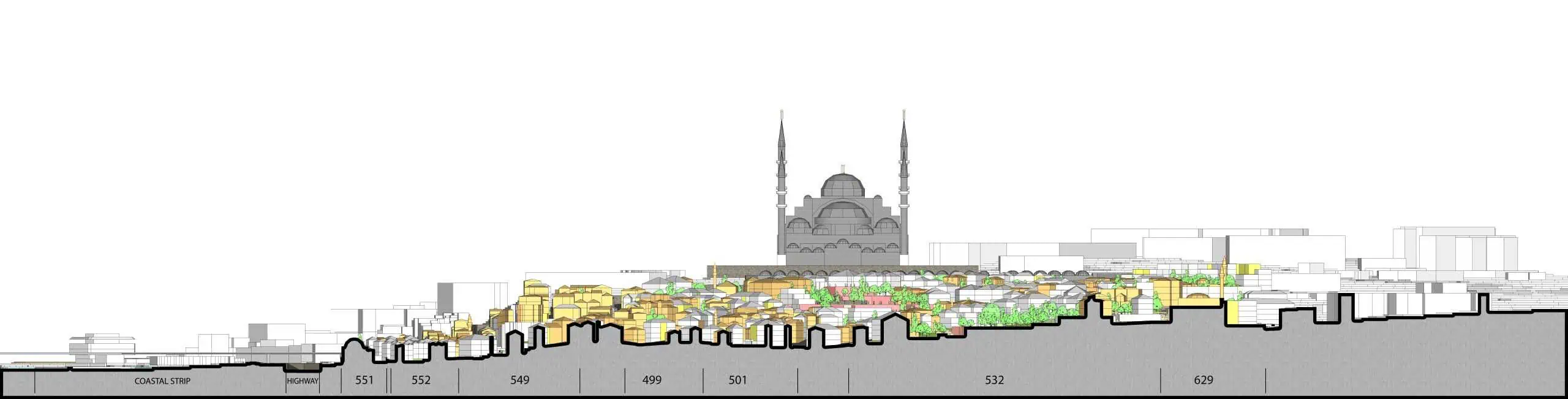


Why Süleymaniye?
At the heart of Istanbul, Süleymaniye is more than a neighborhood — it is a living archive.
Layered with Byzantine and Ottoman memory, street textures, courtyards, and a silhouette that still defines the city’s spiritual skyline, it holds a timeless energy.
But in recent decades, that energy was silenced by fragmented renewal efforts, urban abandonment, and tourism-driven speculation.
The Süleymaniye Development Project, led by Urbanista and Avcı Architects, seeks to revive not just the buildings, but the social and spatial fabric of the district — and to do so without erasing its layers.

A Masterplan That Heals, Not Replaces
Structured across six design phases, the project introduces a phased, bottom-up urban strategy:
- Historical analysis + design principles
- Public-private spatial restructuring
- Typological study of housing, commerce, and community space
- Redefined relationships between interior and exterior realms
- A ‘Living Museum’ approach to showcase intangible heritage
The outcome is not a fixed form, but a regenerative framework — one that adapts, informs, and invites future generations to live in Süleymaniye, not just observe it.
Guiding Values: The 3E Philosophy and Beyond
The Süleymaniye design philosophy is anchored in:
- Ecology: Natural materials, daylight, ventilation, and layered landscape restoration
- Economy: Support for small-scale commerce, local artisanship, and integrated housing
- Ethics: Cultural authenticity, human-scale living, and no displacement
- No gentrification / no tabula rasa: Every structure is read before it is redrawn
This approach values not only what to build, but how to live together in complex historical geographies.
Typology as Cultural Strategy
A deep typological inventory was created, identifying 69 base typologies and 7 circulation-based types. These included:
- Registered buildings: Row houses, mansions (corner, twin, individual)
- New buildings: Infill blocks with central or gallery cores
- Hybrid solutions: “Living above the shop”, mixed-use prototypes, live-work modules
Each plan diagram is not a prescription, but a guide for adaptive reuse and contemporary integration.
Public Realm and Landscape: Between Street and Spirit
Open space design reclaims Süleymaniye’s courtyards, streets, gardens, and monument plots with:
- Public-private gradient logic
- Water features, shade zones, and soft planting inspired by Ottoman gardens
- Local stone, timber, and modest signage strategy
- Art and memory nodes integrated in the urban texture
The goal: not just a clean-up, but a choreography of lived experience.


Living Museum: A New Kind of Cultural Anchor
Within Block 506, a Living Museum is proposed — not as a static archive, but as an evolving cultural platform:
- The Hub: a co-working and storytelling zone
- The Core: representing layered city histories
- The Whisper: dedicated to oral memory and personal narratives
This becomes the emotional core of the Süleymaniye Project — a space of shared identity.
Next project
GE Office Fit-Out
